
AI in Finance: What Every Singapore CFO Should Know
Jatin Detwani
2025-11-26
Singapore’s CFOs are facing a new kind of pressure. Not from regulators, not from auditors, not even from competitors. The real pressure comes from how fast financial decisions now need to be made. The old rhythm of “close books → generate reports → meet leadership → decide next steps” is officially broken. Business moves in real time, and finance must match that speed.
Here is the uncomfortable truth most leaders already suspect: companies are no longer competing on products, they’re competing on intelligence. The winners are those whose finance functions can detect risks earlier, forecast more accurately, and act faster than the market. And the engine powering this shift is unmistakable. What has become the decisive advantage is AI in finance in Singapore.
This article dives deep into how AI-powered CFO tools are redefining modern financial leadership and financial automation in Singapore, not by replacing human judgment, but by supercharging it.
How AI in Finance in Singapore Is Changing the CFO Playbook
AI hasn’t just upgraded financial operations. It has rewritten the job description of a CFO. The role has shifted from being the custodian of numbers to becoming the architect of business strategy.
1. From Data Collection to Data Intelligence
The traditional finance workflow was built on one-time reporting and delayed insights. AI changes that by turning raw data into constantly updated intelligence. Instead of spending hours cleaning spreadsheets, CFOs now spend minutes interpreting real-time insights.
This shift from data handling to data thinking is the single biggest step-change in financial leadership today. And once the data becomes intelligent, the next logical question emerges: How do we make forecasting equally dynamic?
2. Cash Flow Insights Without Manual Modelling
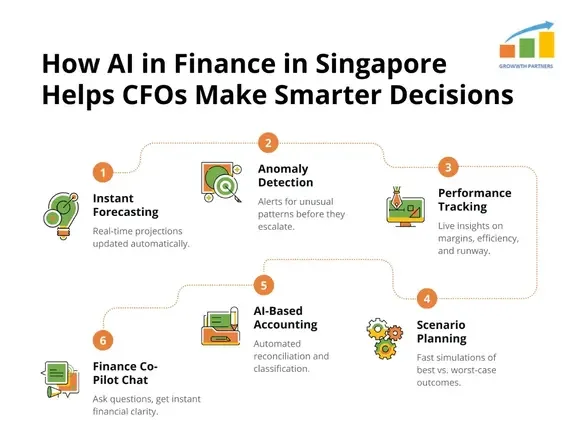
Singapore’s scaling businesses operate in tight cash cycles. AI forecasting models automatically incorporate seasonality, customer trends, payment delays, and category-level spend patterns, giving CFOs a dynamic, always-on cash view.
No more fragile Excel models.
No more forecasts based on last month’s assumptions.
Just real-time clarity, updated every hour.
With forecasting automated, AI then moves to what matters most next — protecting the business through early risk detection.
3. Risk Detection Before It Becomes Expensive
AI analyses spend, margin, revenue movements, vendor behaviour, and cost volatility to detect anomalies the moment they appear. This is crucial in Singapore’s cost-sensitive environment, where late discovery can lead to sudden cash shocks.
A system that flags a broken P&L line immediately is not just an operational benefit; it’s a strategic safeguard. And when risk becomes predictable, finance leaders can finally shift from reporting to steering, the most meaningful transformation AI unlocks.
4. Strategic Decision-Making, Not Operational Admin
When AI automates reconciliation, categorisation, forecasting, and anomaly detection, CFO time gets freed for strategy:
Capital allocation
Pricing intelligence
Market expansion decisions
Scenario-based planning
This is where AI-powered CFO tools offer maximum value, by giving leaders the ability to think, not just tally. So, if your finance function is still stuck preparing reports instead of influencing decisions, AI may be the difference-maker.
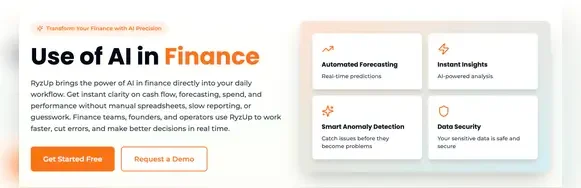
Want real-time forecasting, automated insights, and a finance function that moves at the speed of business? Growwth Partners’ AI in Finance solutions help you get there faster through RyzUp.
What Financial Automation in Singapore Can Look Like
Today’s AI tools behave less like software and more like autonomous financial analysts that work round the clock. They continuously read your data, identify changes, and surface what matters. Here is a glimpse of the impact financial automation can create.
Automated Financial Forecasting
AI produces rolling, self-adjusting forecasts with zero manual intervention. It accounts for revenue cycles, customer delays, burn patterns, and seasonality, building models that stay accurate even in volatile conditions.
Multi-Entity and Multi-Currency Insights
For Singapore-based regional companies, AI eliminates hours of consolidation by creating an instant cross-border, cross-currency view of the business.
AI-Based Accounting and Automation
Finance teams stop chasing numbers and start analysing them. With automation handling categorisation, reconciliation, and error detection, the month-end cycle moves days faster.
AI as a Finance Co-Pilot
CFOs can now treat AI as a conversational partner:
“Where did margins drop this week?”
“What’s driving payroll cost increase?”
“Should we be tightening marketing budgets?”
AI replies with explanations, charts, comparisons, and recommended next steps.
Curious how modern finance teams are winning with intelligent tools? Read this next: Why AI-Driven Finance Teams Are Winning the Future of Business.
How AI Supports Advanced CFO Analytics
AI brings analytical power that manual systems cannot match, enabling CFOs to model reality more accurately and anticipate outcomes earlier.
Predictive Cash Stress Testing
Instead of testing one or two scenarios, AI runs hundreds automatically — analysing vendor patterns, customer behaviour, cost shocks, and macro trends to identify future liquidity risks.
Driver-Based Forecasting
AI identifies the real drivers of your business: CAC, retention, inventory cycles, OPEX behaviour, hiring patterns. It updates forecasts the moment any driver changes.
Real-Time Budget Control
AI compares actuals vs. budgets in real time, allowing CFOs to act today, not wait for month-end, when variances emerge.
This is not “better reporting.” This is a finance function capable of anticipating the future, not reacting to the past. But the true power of AI comes when organisations are ready to adopt these systems intelligently.
Future-proof your cash flow decisions with AI-driven modelling and forecasting. Speak to a cash flow modelling expert today!
Preparing Your Organisation for AI in Finance
Implementing AI is not a technical project. Rather, it has to be regarded as a leadership project. The most successful CFOs follow three principles:
1. Build a Unified Financial Data Layer
AI can only be as strong as the data it reads. Integrate accounting, bank feeds, payroll, and operational systems so the AI has complete visibility.
2. Upskill Your Finance Team
Your team’s value shifts from data entering → to data interpreting. Train them to read anomalies, understand model logic, and use insights for strategic decisions.
3. Start with a High-Impact Pilot
Choose one area with measurable outcomes from forecasting, reconciliation, or budget tracking. Prove value, then expand across the finance stack.
When organisations adapt mindsets, and not just systems, AI in finance becomes a multiplier and not just a tool.
Want to go deeper on predictive finance? Read: Cash Flow Modelling: Why a Part-Time CFO Is a Game Changer for Singapore SMEs.
Conclusion: AI Is Redefining the Financial Leadership Standard in Singapore
The next generation of Singapore CFOs will not be defined by how fast they close books, how well they manage spreadsheets, or how accurately they report the past. They will be defined by how intelligently they predict the future.
AI does not replace finance leaders. It elevates the ones who embrace it, giving them sharper visibility, faster insights, and a strategic edge competitors cannot replicate manually.
Growwth Partners helps forward-thinking CFOs lead this shift with RyzUp, the AI-powered finance engine built for Singapore’s modern business landscape. Transform your finance with AI precision.
Frequently Asked Questions
Common questions about this topic
Related Services & Solutions
Accounting Services in Singapore
Leverage our generative AI development services to streamline workflows, boost productivity and drive innovation, while ensuring seamless integration with your existing systems.
Part-Time CFO Services
Optimize your business potential with our comprehensive generative AI consulting services, designed to guide you in leveraging GenAI for operational excellence and product innovation.
Bookkeeping Services in Singapore
Unlock AI's full potential for your business through our comprehensive AI development services, designed to tackle intricate tech challenges, streamline business workflows, and achieve operational excellence.
Ready to Strengthen Your Financial Strategy?
Book a free consultation to discuss your business goals.
