
Fractional vs Full-Time CFO in Singapore: What's Actually Worth Paying For in 2026
Key Takeaways

Cost Comparison
A fractional CFO costs S$3K–S$10K/month vs S$250K–S$450K+/year for a full-time hire, delivering 80–90% of the strategic value.

CA vs CFO
Your chartered accountant handles backward-looking compliance; a fractional CFO handles forward-looking strategy. They solve different problems.

Revenue Sweet Spot
Fractional CFO is ideal for businesses earning S$1M–S$15M. Below S$1M, a CA suffices. Above S$15M–S$25M, consider full-time.

Singapore Context
statutory, IRAS, GST, SFRS compliance plus ASEAN expansion opportunities require CFOs with specific local regulatory expertise.

Decision Framework
Use a structured framework based on revenue, complexity, fundraising plans, and team size to choose the right financial leadership model.
Is a Fractional CFO Worth It, or Can My Accountant Handle Everything?
Short answer: Your chartered accountant (CA) handles compliance. A fractional CFO handles strategy. They solve completely different problems, and confusing the two is one of the most expensive mistakes Singapore SMEs make.
Here is how the responsibilities break down in practice. Your CA or external accountant is the right person for backward-looking compliance work:
- Filing annual returns with statutory
- Preparing financial statements in XBRL format for BizFile+
- Submitting ECI and Form C-S or Form C to IRAS
- Processing monthly GST returns if revenue exceeds S$1 million
- Managing payroll and CPF contributions
A fractional CFO, on the other hand, is forward-looking. Their job is to help you make better decisions about the future:
- Building financial models that show what happens if you expand into a second market
- Forecasting cash flow 13 weeks out so you never get blindsided by a shortfall
- Preparing investor-ready decks and data rooms for your Series A
- Negotiating better terms with banks and creditors
- Setting KPIs that actually connect to profitability, not just vanity metrics
- Running scenario analysis for pricing changes, hiring plans, or new product launches
Key Insight:
Think of it this way: your accountant tells you what happened last quarter. A fractional CFO tells you what to do next quarter. If your business is past the compliance-only stage and you are making decisions about growth, fundraising, or expansion, the CA alone is not enough.
What Should I Outsource to a Fractional CFO vs. Keep In-House?
This is the question that trips up most founders. The instinct is to either outsource everything or keep everything in-house. Both extremes waste money. The right approach is to think in terms of two dimensions: how strategically important the task is, and how frequently it needs to happen.
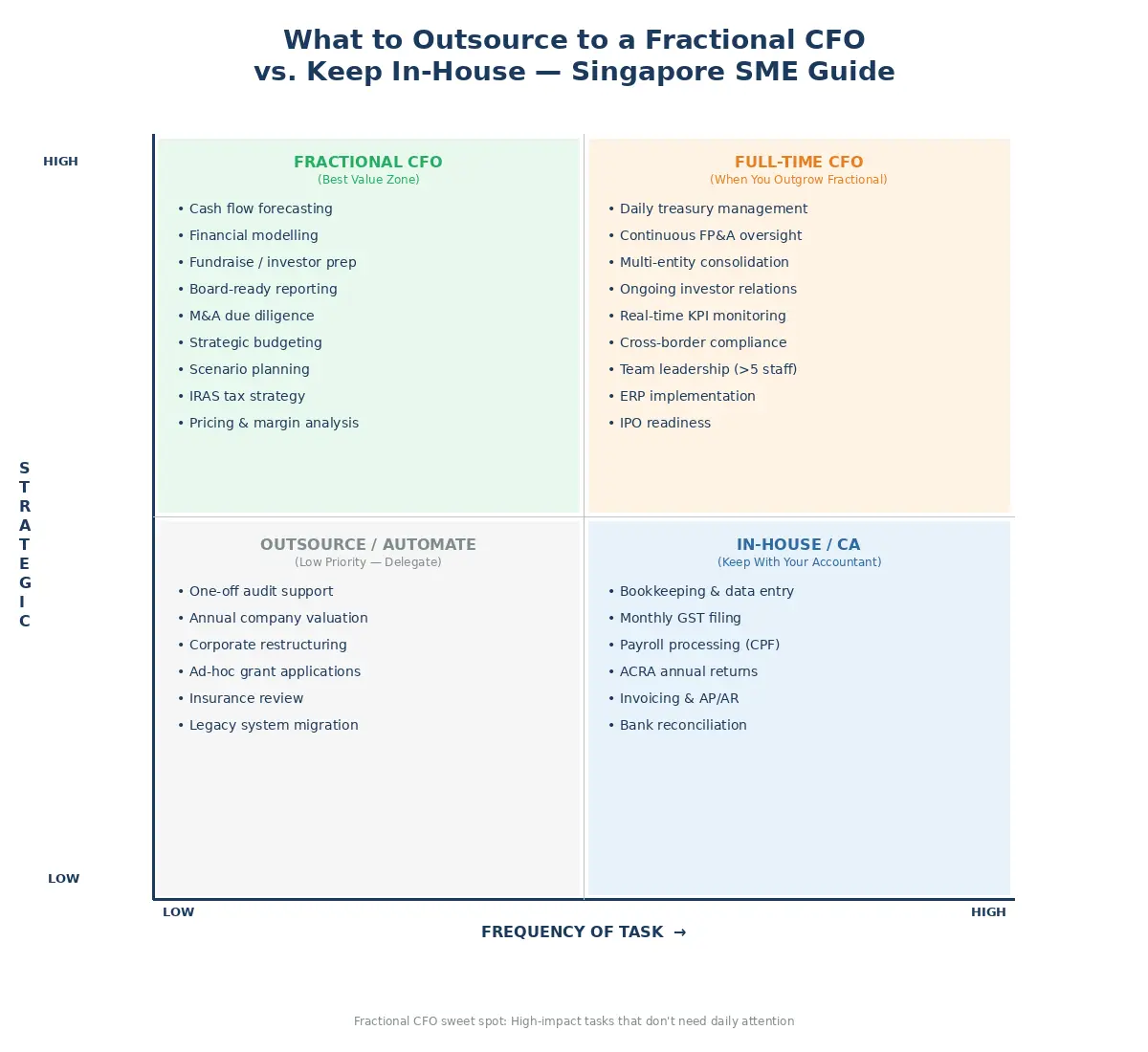
The top-left quadrant is the fractional CFO sweet spot: tasks that are highly strategic but do not require someone in your office five days a week. Cash flow forecasting, financial modelling, board-ready reporting, fundraise preparation, and IRAS tax strategy all fall here.
The bottom-right quadrant belongs to your CA or in-house bookkeeper: bookkeeping, GST filing, statutory annual returns, invoicing, and bank reconciliation. These are important but routine.
The top-right quadrant is where you eventually need a full-time CFO: when daily treasury management, continuous FP&A oversight, multi-entity consolidation, and real-time KPI monitoring become necessities. For most Singapore SMEs, that transition point arrives somewhere between S$15M and S$25M in annual revenue.
Cost Comparison: Fractional CFO vs. Full-Time CFO vs. CA/Accountant
Numbers matter more than narratives when you are making this decision. Here is a side-by-side comparison benchmarked to the Singapore market:
| CA / Accountant | Fractional CFO | Full-Time CFO | |
|---|---|---|---|
| Annual Cost (SGD) | S$2,000–S$8,000/yr | S$36,000–S$120,000/yr | S$250,000–S$450,000+/yr |
| Monthly Retainer | S$150–S$700/mo | S$3,000–S$10,000/mo | N/A (salaried) |
| Hours/Month | As needed | 8–40 hrs/month | Full-time (160+ hrs) |
| Strategic Depth | Low (compliance focus) | High (strategy + execution) | Very High (embedded) |
| Fundraising Support | None | Yes (models, data rooms) | Yes (full ownership) |
| Cash Flow Forecasting | Basic / historical | 13-week rolling forecasts | Real-time, daily |
| Board/Investor Reporting | No | Yes | Yes |
| statutory and IRAS Compliance | Yes (primary role) | Oversight & strategy | Full ownership |
| Best For | < S$1M revenue | S$1M–S$15M revenue | > S$15M–S$25M revenue |
Table 1: Singapore Fractional CFO vs Full-Time CFO vs CA Cost Comparison (2026)
Realistic Fractional CFO Rates in Singapore: What You Should Actually Pay
Pricing transparency is notoriously poor in the fractional CFO space. Here is what the Singapore market actually looks like in 2026:
| Engagement Type | Typical Range (SGD) | Hours/Month | Best For |
|---|---|---|---|
| Hourly Rate | S$200–S$450/hr | As needed | Project-based or ad-hoc advisory |
| Monthly Retainer (Startup) | S$3,000–S$6,000/mo | 8–15 hrs | Early-stage, pre-revenue to S$3M |
| Monthly Retainer (Growth) | S$6,000–S$10,000/mo | 15–30 hrs | Growth stage, S$3M–S$10M |
| Monthly Retainer (Scale-up) | S$10,000–S$15,000/mo | 30–40 hrs | Scaling, S$10M+ with complexity |
| Project-Based | S$15,000–S$75,000 | Varies | Fundraising, restructuring, M&A prep |
Table 2: Fractional CFO Pricing Guide for Singapore (2026)
How to Avoid Overpaying for Fractional CFO Services
There are several red flags to watch for when evaluating fractional CFO providers in Singapore:
🚩 Red Flag #1: Bundled Bookkeeping
Be wary of firms that bundle controller-level or bookkeeping work into a CFO retainer. If someone is calling themselves a fractional CFO but spending most of their hours on data entry, reconciliation, or basic compliance filings, you are overpaying for the title. A genuine fractional CFO should be spending the majority of their hours on strategy, forecasting, and decision support.
🚩 Red Flag #2: Vague Scope of Work
Insist on a clearly defined scope of work before signing any engagement. The retainer should specify deliverables, not just hours. What reports will you receive, how often, and in what format? Will they attend board meetings? Will they prepare investor materials? Ambiguity in scope is the primary reason businesses feel they are overpaying.
🚩 Red Flag #3: No Local Regulatory Expertise
Check whether the fractional CFO has direct experience with Singapore's regulatory environment, including statutory filing requirements, IRAS tax provisions like the Startup Tax Exemption Scheme (SUTE), GST registration thresholds, and the Companies Act. A US- or UK-trained CFO working remotely may offer strong strategic insight but miss critical local nuances around CPF, Employment Act compliance, or transfer pricing for cross-border operations.
Decision Framework: Which Option Is Right for Your Business?
Here is the framework distilled into simple decision rules:
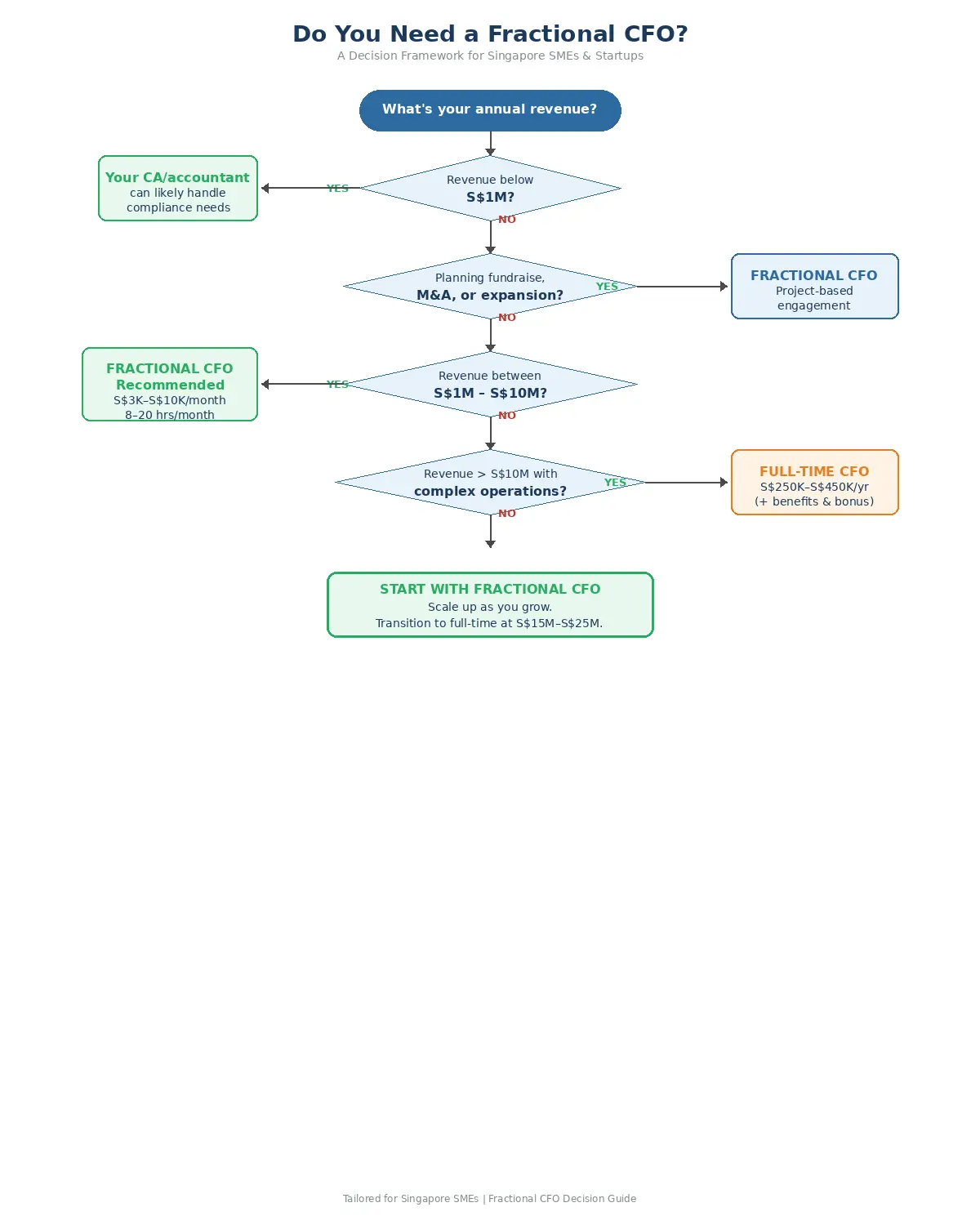
✅ Stick with your CA if:
- Annual revenue is below S$1M
- Finances are straightforward—single entity, no investors
- Not planning to raise capital in the next 12 months
- Primary need is compliance: statutory filings, IRAS returns, and GST
🎯 Hire a Fractional CFO if:
- Revenue is between S$1M and S$15M
- Preparing to raise funding or actively in investor discussions
- Need cash flow forecasting beyond what accounting software provides
- Business operates across multiple revenue streams or geographies
- Need board-ready financial reporting but cannot justify a S$300K+ salary
- Going through a significant transition: expansion, restructuring, or exit preparation
🏢 Hire a Full-Time CFO if:
- Revenue consistently exceeds S$15M–S$25M
- Managing multiple entities requiring daily consolidated oversight
- Finance team of five or more people who need leadership
- Active in M&A, IPO preparation, or complex cross-border operations
- Volume of financial decisions requires someone embedded every day
Why the Singapore Context Matters
Singapore's regulatory landscape adds specific dimensions to the fractional CFO decision that do not apply in other markets. The compliance burden for even a small private limited company is non-trivial:
- Annual returns must be filed with statutory within seven months of the financial year end
- Financial statements must comply with Singapore Financial Reporting Standards (SFRS)
- ECI must be filed within three months of the financial year end
- Companies with revenue exceeding S$1M must register for and file quarterly GST returns
Beyond compliance, Singapore's position as a regional hub creates unique strategic opportunities. A good fractional CFO for a Singapore SME should understand:
- Regional expansion considerations for ASEAN markets
- Transfer pricing implications for cross-border transactions
- Government grants and incentives available through Enterprise Singapore
- The Startup Tax Exemption Scheme for qualifying new companies
- Holding structure optimisation for businesses with regional subsidiaries
Key Takeaway:
These are not generic CFO skills. They require specific knowledge of the Singapore ecosystem, which is why hiring a fractional CFO with local expertise is important—even in a world where virtual and remote engagement models are increasingly common.
Frequently Asked Questions
Need Help With Your Business?
Our team of experts is ready to provide you with personalized advice and solutions.
